
Under-Cabinet Lighting That Keeps a Dark Worktop Usable
A dark worktop absorbs light, so under-cabinet lighting has to be planned for even coverage, warm colour and minimal glare before the kitchen is fitted.
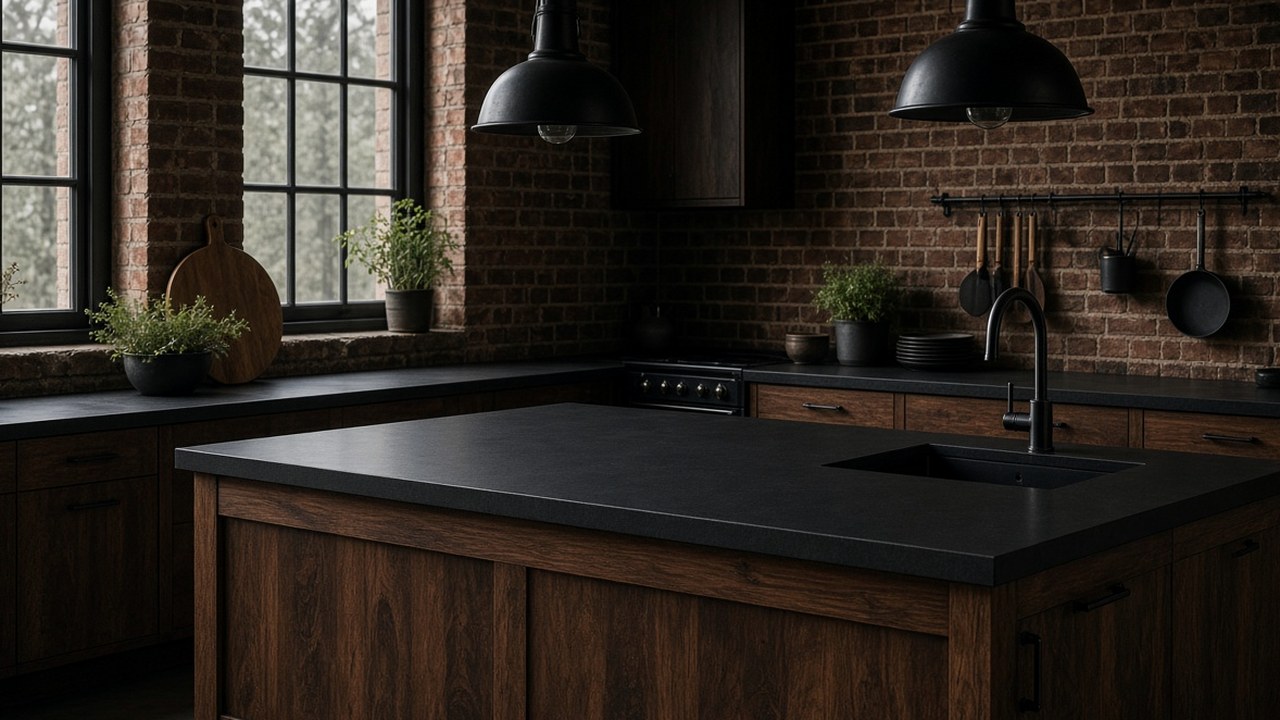
A dark worktop is a beautiful thing at dusk, but it is also a surface you need to work on. Charcoal and black absorb light, so without good under-cabinet lighting the prep area can feel dim even in a well-lit room. Work-Tops plans lighting at the same time as the worktop because the two are inseparable in a dark kitchen. The aim is even, warm light across the whole depth of the deck without glare or hot spots.
Put the light where your hands work
Under-cabinet lights are often fitted towards the back of the cabinet, close to the wall. That lights the splashback well but leaves the front of the worktop, where you chop, in shadow. For a dark deck, position the strip closer to the front edge of the wall cabinet underside, so the light falls across the full depth of the worktop.
A continuous LED strip gives more even coverage than individual puck lights, which create pools of light and dark patches in between. On a pale worktop, those pools look soft; on a dark worktop, they become obvious bright spots.
- Mount LED strips towards the front of the cabinet underside.
- Choose continuous strips rather than spaced puck lights.
- Check that the light covers the front of the worktop, not just the wall.
Use a diffuser to prevent dotted reflections
Many dark worktops, particularly those with a satin finish, reflect the individual LEDs as a line of dots. A good aluminium profile with an opal diffuser softens the light into a continuous line and reduces those reflections. Deeper diffusers blend the light better but take up slightly more space.
Ask your electrician or kitchen fitter to hold the chosen strip and diffuser over a worktop sample before installation. It is much easier to change the product at that stage than to replace it after the worktop and cabinets are fitted. There is more about sheen in dark rooms in matt acrylic faces in espresso and charcoal kitchens.
Choose a warm colour temperature
Colour temperature is measured in kelvin. Warm white, typically around 2700K to 3000K, flatters dark worktops and gives an inviting evening glow. Cool white, around 4000K and above, is crisp and bright but can make charcoal look grey and a little clinical. Most dark kitchens look best with warm white under-cabinet lighting matched to the ceiling lights.
Check the colour rendering index (CRI) too. A higher CRI shows colours more accurately, which matters when you are judging whether food is cooked and when you want the worktop colour to look as it did in the showroom.
- Warm white suits most dark worktops.
- Match under-cabinet and ceiling light colour temperatures.
- A higher CRI makes food and surfaces look more natural.
Plan switching and dimming
Under-cabinet lighting in a dark kitchen does two jobs: bright task light for cooking and soft mood lighting in the evening. A dimmer lets the same strip do both. Separate switching for the under-cabinet lights, ceiling lights and any plinth or shelf lighting gives flexibility.
Think about where the switch will be. Many people like a switch near the kitchen entrance and another near the hob. Smart controls are an option but not essential. The important thing is that the lighting is easy to use every day.
Account for glare from a seated position
If your kitchen has an island with seating facing the perimeter run, look at the under-cabinet lights from a seated position. Exposed LEDs can shine straight into the eyes of people at the island. A recessed profile or a small pelmet on the cabinet underside hides the light source.
This also matters in open-plan rooms, where the sofa might have a sightline to the kitchen. A dark worktop reflects some light upwards, so the combination of exposed LEDs and a satin surface can create glare you notice in the evening.
Coordinate with the worktop fabricator
Lighting cables often need to pass through or behind the worktop, particularly if you want lighting under open shelves or in a recess. Tell the templater where cables will run so any notches or holes are planned before cutting. On a dark worktop, a poorly placed cable exit is very visible.
If you plan lighting in the worktop itself, such as a recessed LED strip along a breakfast bar edge, discuss it with the fabricator early, because it affects the edge detail and the internal construction. Work-Tops describes evening islands in charcoal island blocks lit by warm pendant pools.
Lighting where there are no wall cabinets
Many modern kitchens have open shelving or no wall cabinets at all. Without cabinets, under-cabinet strips have nowhere to go. Options include LED strips under open shelves, adjustable spotlights angled at the worktop, pendant lights over islands and wall lights above the splashback. A dark worktop needs this task lighting even more than a pale one.
- LED strips under shelves.
- Angled ceiling spotlights.
- Wall lights above the splashback.
Maintenance and replacement
LED strips last a long time, but drivers can fail. Position drivers where they can be reached without removing the worktop or cabinets, and keep a note of the strip and driver specification for replacements.
Questions about lighting dark worktops
What colour LED is best for a black worktop?
Warm white is usually the most flattering. Cool white can make black and charcoal look grey and harsh.
Why can I see dots of light reflected in my dark worktop?
The individual LEDs are reflecting in the surface. A profile with an opal diffuser usually solves the problem.
Do I need under-cabinet lights if I have good ceiling lights?
With a dark worktop, yes in most cases. Ceiling lights cast your shadow onto the work surface, while under-cabinet lights illuminate the area in front of you.
How do I light a dark worktop without wall cabinets?
Use LED strips under shelves, angled spotlights, wall lights or pendants over islands.
Should under-cabinet lights be on a separate switch?
It is useful, so you can use them as task lighting or soft evening lighting independently.
Where should LED drivers be placed?
Somewhere accessible, such as inside a cabinet, so they can be replaced without disturbing the worktop.
Can LED strips be replaced easily?
Usually, if the strip specification is recorded and the channel is accessible.
Next step with Work-Tops
Order a sample, then request a fitted quote or browse the worktop collection. The colour should be judged in your own daylight before anyone templates the run.