
Templating a Narrow Galley Before Anyone Cuts Sheet
Narrow galleys leave no spare millimetres, so sockets, splash returns and the walking line must be mapped before anyone cuts a solid-surface run.
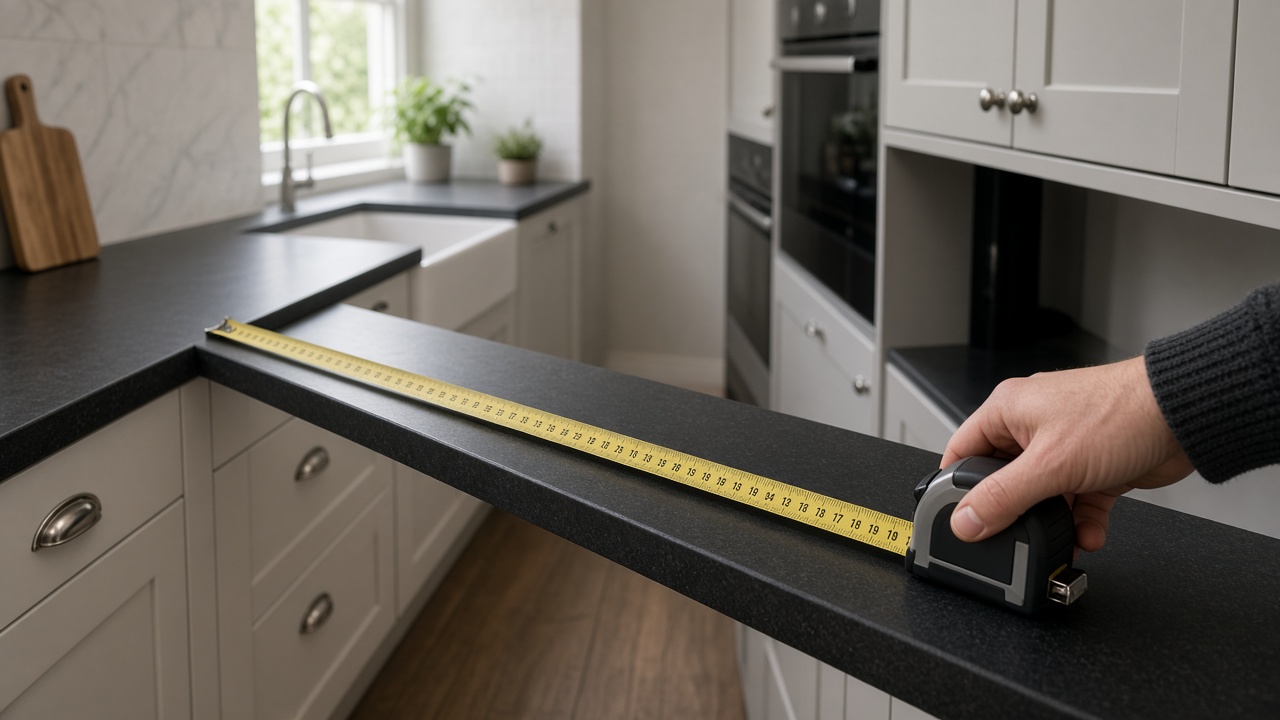
A galley has no spare millimetres, and an error that would vanish on an island becomes a door that catches or a run that dies short of the dresser. Work-Tops treats the template as a drawing of how you walk the room, not only as a tracing of cabinet tops. Cabinets must be packed and level before that visit, because solid surface is cut off site and will not be scribed like timber.
Narrow aisles punish a measure taken from a brochure
Most British galleys we see are between 1.8 and 2.4 metres wall to wall, with a walking line of 900 millimetres or less. Base units are often 570 millimetres deep once the door and handle are counted. A worktop that arrives 15 millimetres over will steal the aisle; one that arrives shy will leave a shadow gap against a dresser that cannot move. Quartz slabs are sometimes scribed on site. A thermoformed solid-surface run is fabricated off site, so the millimetres have to be right on the template visit.
Do not template until the cabinets are packed, fixed and confirmed level. Mark every socket, switch and window board, including those that sit forty millimetres below the finished worktop line. A coved upstand will not hide a spur that was never drawn.
Record sockets, splash and every door that eats the aisle
If the splash is a separate solid-surface panel, template it on the same visit so the joint lands on a stud, not on a run of tiles you planned to keep. Walk the aisle with the templater. Point out where a hip meets an open dishwasher, where a bin door swings, and where you stand to chop. Overhangs that feel generous on a drawing become bruises in a 900 millimetre galley. Front overhangs of forty millimetres look fine on an island brochure. In a galley, twenty to twenty-five millimetres is enough to shade the doors and still let you stand close.
Walk the aisle with the back door open if the galley meets a yard. Coat pockets and tea towels catch on a deep nose you never needed.
- Do not template until the cabinets are packed, fixed and confirmed level.
- Record sockets and window boards that sit just below the finished plane.
- Walk the aisle with the templater and mark every door swing.
Cut-outs steal meat you do not have on a 600 cabinet
A 1.5 bowl sink in a 600 millimetre cabinet leaves almost no meat around the cut-out. In solid surface the bowl can be integral, which returns those millimetres to the deck and keeps the tap on a small pad instead of a cramped stainless flange. If you insist on a separate undermount, choose a compact bowl and confirm the cabinet rail will still take the clips after the cut. Hob cut-outs want the same honesty. An eighty-centimetre induction plate in a narrow run leaves thin strips that flex. Move the hob to a slightly wider cabinet or drop to a sixty-centimetre plate.
Dark galleys already look longer when the plane is uninterrupted; a smaller hob is often the better evening silhouette. Prefer an integral bowl when the cabinet is only 600 millimetres wide.
Sign a dimensioned drawing the same day, then dry-fit
Ask for a dimensioned drawing the same day as the template. Check overall lengths, the distance from the window reveal to the first cut-out, and the finished overhang at the aisle. If a number disagrees with a tape you trust, stop the job. Fabrication will not improve a wrong digital file. On fit day, dry-run the pieces before adhesive. A galley has no second wall to hide a twist. If a return needs a fraction taken off, it is better done with the piece still unbonded. Once the joints are pulled up, you are living with the millimetres you signed.
- Demand a same-day drawing and check it against your own tape.
- Dry-fit every piece in the galley before any joint is pulled up.
- Prefer an integral bowl when the cabinet is only 600 millimetres wide.
Next step with Work-Tops
Order a sample, then request a fitted quote or browse the worktop collection. The colour should be judged in your own daylight before anyone templates the run.